
Madison County Arrest Records and Charges
Madison County arrest records identify the custody event. The Sheriff's roster can show a name, booking number and time, gender, race, age, charge description, bond amount, hold, and profile link. These are booking-level facts. A charge description on the roster may be short or group more than one accusation. It is not the court's final statement of what was prosecuted.
After arrest, the District Attorney evaluates the case and files or pursues formal charges where supported. Those charge entries become part of the court file held by the Circuit Clerk. Robert L. Broussard's Madison County District Attorney's Office prosecutes all county felonies and some misdemeanors. The court record, not the initial booking line, tracks the later charge status and outcome.
Find Madison County Arrest Records
Use the official Madison County inmate roster for current or recently released booking information. Search by name or show all results, then verify booking time, number, bond, hold, and listed description. The roster is free, but it covers people booked into the county facility. It is not a complete historic arrest database and does not show every person with an active case.
- Search the Sheriff's roster for the arrest or booking side.
- Open Alacourt ACCESS for the filed Circuit or District court case.
- Search by defendant name or exact case number and verify Madison County.
- Read each charge, count, amendment, plea, disposition, and sentence entry.
- Request clerk copies when a charging paper or certified record is needed.
Alacourt charges $9.99 for either a name or case-number search. Images cost extra. A case report can show basic information, court action, status, setting dates, parties, finances, and the case action summary. For the complete progression beyond the accusation, use the Madison County criminal case file.
Madison County Charges After Arrest
The arresting accusation and filed court charge are related but not identical. A complaint starts many proceedings by stating alleged facts and offenses. An information is a prosecutor-filed charging document used in some procedures. An indictment is returned by a grand jury for a felony. The specific charging route depends on the case, so the filed document and later court entries control.
| Complaint | Information | Indictment | |
|---|---|---|---|
| Source | Filed accusation supported by alleged facts | Prosecutor-filed accusation | Grand jury charging action |
| Record role | States the initial court charge | States charges selected for prosecution | States felony counts returned by grand jury |
| What to check | Later amendments and disposition | Later amendments and disposition | Each count, plea, and disposition |
Madison County Charge Status
Charge status changes as evidence, legal rulings, plea talks, and prosecutorial decisions shape the case. One arrest can create several counts, and each count can end differently. Read the latest action and disposition for each count. A booking label may remain unchanged even after the court charge has been reduced or dismissed.
| Status | What It Means |
|---|---|
| Pending | The filed accusation has not reached a final reported outcome. |
| Amended | The filed language, count, or legal basis has changed. |
| Reduced | The prosecution proceeds on a less severe charge. |
| Dismissed | The court case or count ends without a conviction on that charge. |
| Nolle prosequi | The prosecutor formally declines to continue that prosecution at that point. |
| Convicted | A plea or verdict establishes guilt and leads to disposition or sentence. |
Madison County Charges vs Convictions
Neither arrest nor charge equals guilt. A charge is the formal accusation placed before the court. A conviction follows a guilty plea or verdict. A person may have been arrested, then face a reduced charge, dismissal, acquittal, or conviction on only some counts. Accurate reading requires the final disposition rather than the first roster description.
| Charge | Conviction | |
|---|---|---|
| Stage | Accusation | Verdict or plea |
| Meaning | Accusation chosen for prosecution | Guilt established by plea or verdict |
| Can change | May be amended, reduced, or dismissed | May be subject to appeal or later court relief |
| Key record | Charging paper and amendments | Disposition and sentencing order |
Madison County Sealed vs Expunged Charges
Sealing limits public access while the court retains the record. Alabama expungement law can restrict public access to an eligible covered charge after the Circuit Court grants relief. It should not be described as automatic destruction. The Madison County Criminal Division provides expungement resources but cannot advise a person about eligibility.
- Visibility
- A sealed charge is blocked under court authority. An expunged charge is restricted after a qualifying order.
- Record control
- The court retains a sealed file. Expunged records remain governed by Alabama statute.
- Eligibility
- Sealing depends on case-specific authority. Expungement depends on Alabama Code sections 15-27-1 or 15-27-2.
Madison County Charge Codes and Levels
A charge label should be matched to its statute, count, and court. Felonies route to Circuit Court for trial, while District Court handles misdemeanors and preliminary felony stages. Municipal courts handle city misdemeanors and ordinance violations. A short roster description may omit the code or collapse more charges behind a summary, so it should not be used to assign a final severity level.
Bond and holds are separate fields. A bond amount addresses release conditions, not guilt or charge outcome. A hold may identify another agency or reason that custody continues. The Madison County jail directs county misdemeanor and felony bond questions to the District Court Clerk at 256-532-3373.
Madison County State and Local Charges
Alacourt is the statewide official trial-court lookup for filed Alabama cases, but it is not the same as a certified statewide criminal-history report. The Sheriff's roster is local custody data. The Alabama sex offender registry is another separate statewide record channel and must not be treated as a general arrest or charge database.
The Circuit Clerk can supply court copies through its records-request form by mail or in person. Madison Municipal Court and Huntsville Municipal Court maintain city cases outside the county criminal division when their city jurisdiction applies. Identify the arresting agency and handling court before searching.
Madison County Arrest and Charge Limits
Name matching is not enough. Confirm the booking number, case number, court, count, and final disposition. Public records can be incomplete, delayed, or later changed. An arrest record and charge record should not be used as proof of conviction, and a private lookup does not become a compliant employment, housing, credit, or insurance report.
Important: This private resource is not a consumer reporting agency and cannot provide an FCRA-compliant background report.
Restricted Madison County Charge Records
Juvenile court records are confidential under Alabama Code section 12-15-133. Sealed or expunged charges are not available through ordinary public access. Active investigations, protected victim information, medical data, Social Security numbers, full account numbers, minor identifiers, and protected addresses may also be withheld or redacted.
Public access starts with the correct custodian and remains subject to court rules. A roster may reveal arrest-related details after booking, yet an unserved or sealed charge may not be confirmed publicly. Court staff can explain access steps but cannot give legal advice.
Madison County Booking Custodian
The Madison County Sheriff's Corrections Division operates the county detention function. Its assigned image provides context for the booking side of the arrest-to-charge path.

The division holds people in local custody, while court charges and outcomes remain with the trial courts and Circuit Clerk.
Sheriff Kevin H. Turner's administration page is the source for the next assigned image.
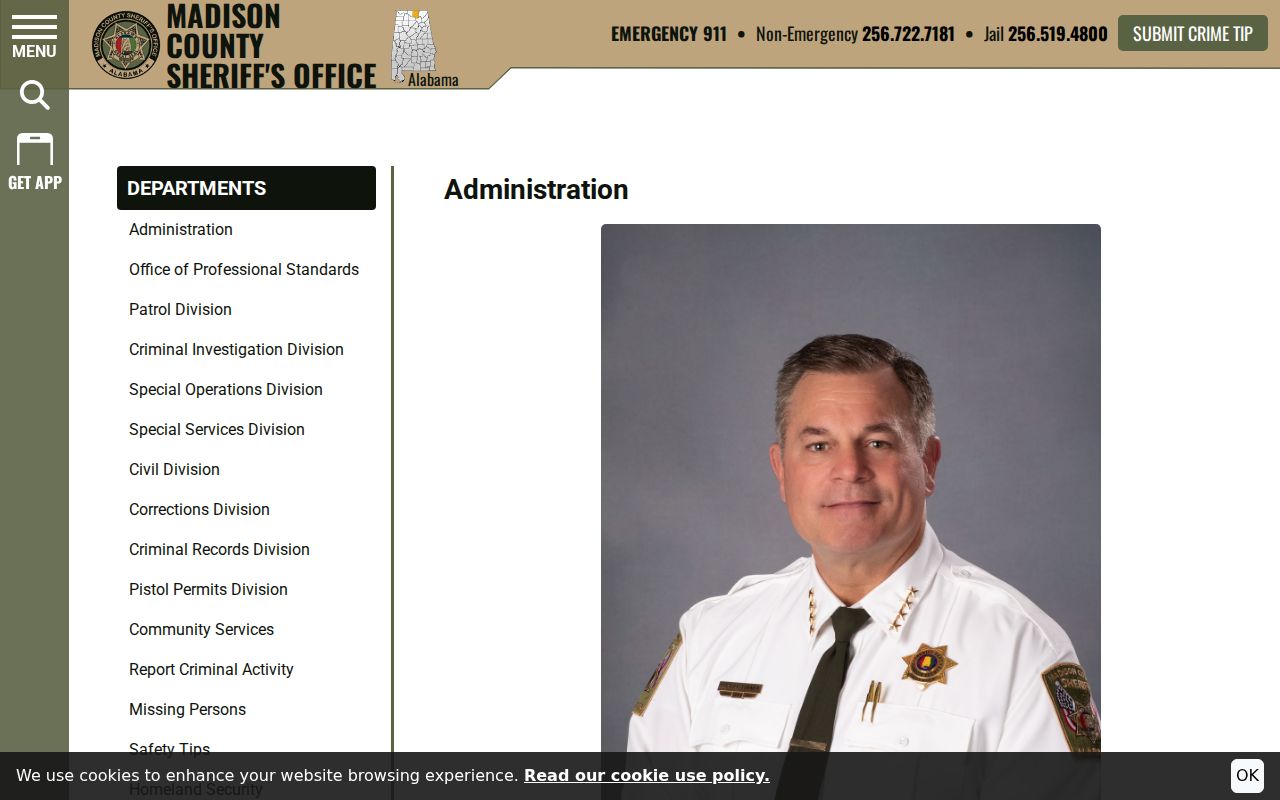
The Sheriff's Office creates and maintains custody information, but prosecution decisions belong to the District Attorney and filed case record.
Madison County Arrest Record Context
The official Sheriff's history lists officeholders back to 1808, before Alabama statehood. The assigned image documents that local institutional source.
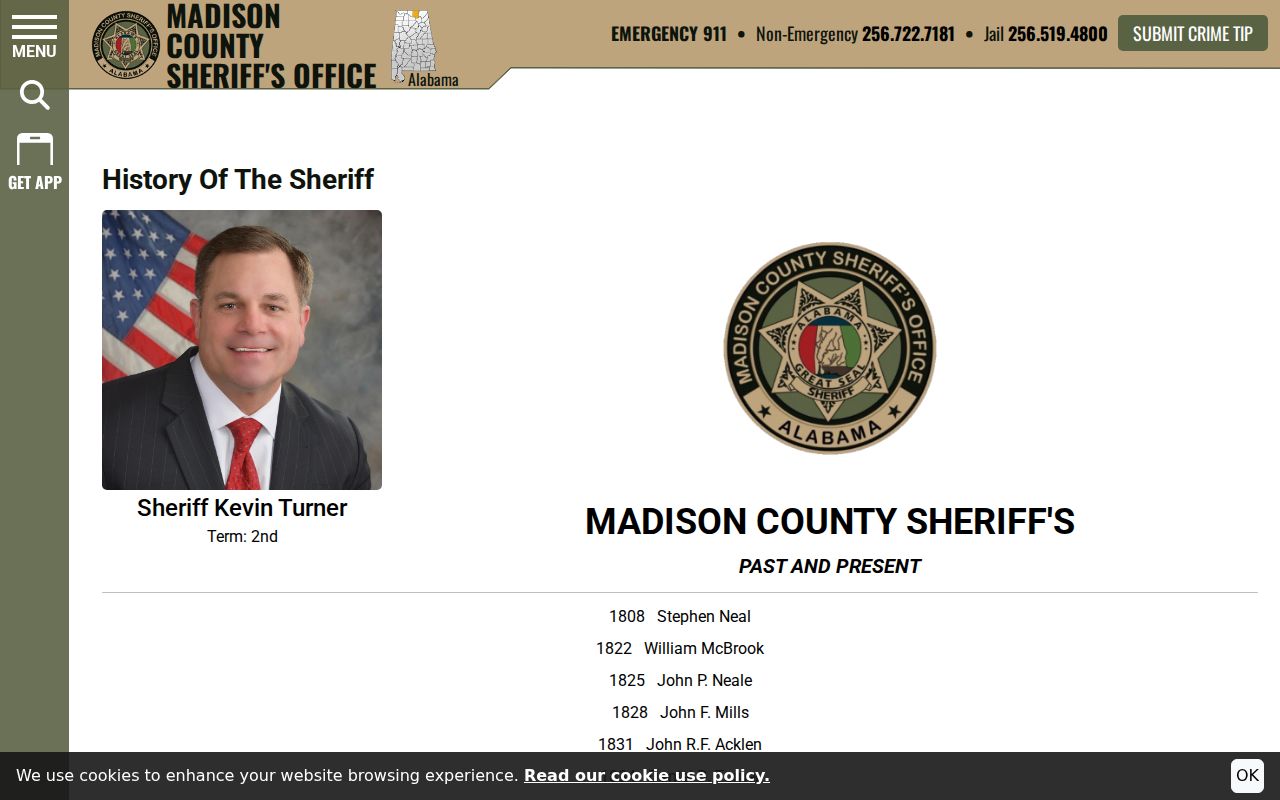
Modern arrest, booking, and court-charge records now pass through separate electronic systems, but the custodian split between sheriff, prosecutor, and courts remains essential.
Madison County Arrest Bond and Hearings
Bond information links custody to the next court step but does not decide the charge. The detention facility says county misdemeanor and felony bonds can be posted through the District Court Clerk, and it gives 256-532-3373 for bond questions. A person who remains in custody on a felony warrant receives a 72-hour hearing in District Court where the person is told the charges and bond. That hearing is a custody and notice stage, not the final disposition.
Municipal paths differ. Huntsville city misdemeanor bond information comes from the City Magistrate in the jail lobby or 256-427-7817. Madison city misdemeanor bond questions route to Madison Municipal Court at 256-772-5617. Madison city defendants may have court Tuesday at the jail or Thursday at the municipal building depending on the charges. Court and agency identity should be recorded with the booking number before tracing charges after arrest.
Madison County Prosecutor Charge Role
The District Attorney represents the people of Alabama in all Madison County felony prosecutions and some misdemeanors. Crimes should first be reported to law enforcement for investigation, not sent directly to the prosecutor as a request to file charges. The DA and assistants cannot give legal advice to the public or act on private legal matters. Defendants are directed to communicate through counsel.
The office's units include victim services, family violence and sexual assault, pre-trial intervention, Drug Court, Veterans Court, restitution recovery, investigations, and grand jury work. These programs can affect how a charge proceeds, but an office program list does not show the status of a specific case. The filed charging document and latest court actions remain the sources for that answer.